


Wire Pay Off Spooling Unit
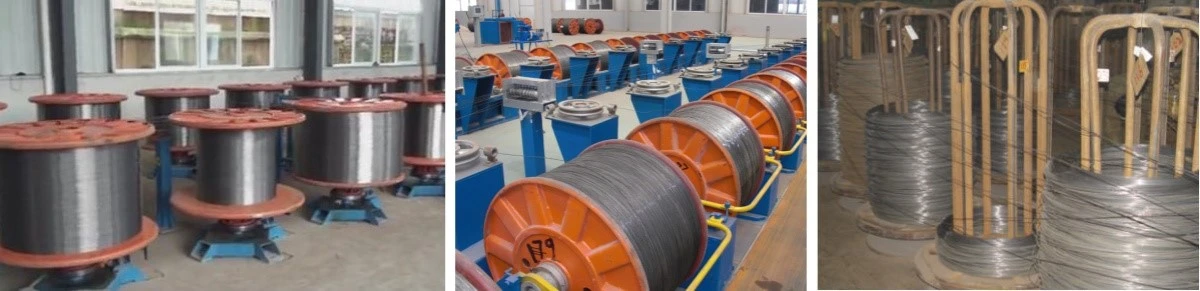
Passive Wire Pay-off
Name: Passive I Beam Wire Pay Off Stand
Overview:
It is suitable for wire pay off in electro galvanizing and hot dip galvanizing wire production lines. The equipment consists of a rotating base and a pay off stand. The rotating base is equipped with a tensioning device to control the wire pay off tension, and the pay off stand can be freely replaced during production.
Active Wire Pay-off
Name: Active I Beam Spool Pay Off Equipment
Overview:
The equipment adopts an accumulator type pay off unit to ensure stable wire tension without looseness. The wire accumulation time is not less than 3 minutes, allowing the I beam spool to be replaced without stopping the production line. The spool replacement is simple and convenient to operate. The electrical control system is installed in an independent control cabinet together with the take up unit electrical system. The pay off and take up units are interlocked and the wire tension is automatically tracked and adjusted during operation.
Wire Pay-off Specifications
The equipment is customized according to the type of wire products and the production line speed required by the user.
Application Parameters for Wire Pay-off
|
Application Position |
Material |
Applicable Spool Diameter Range |
|
Wire Pay-off |
Metal |
Φ800~Φ1100 (mm) |
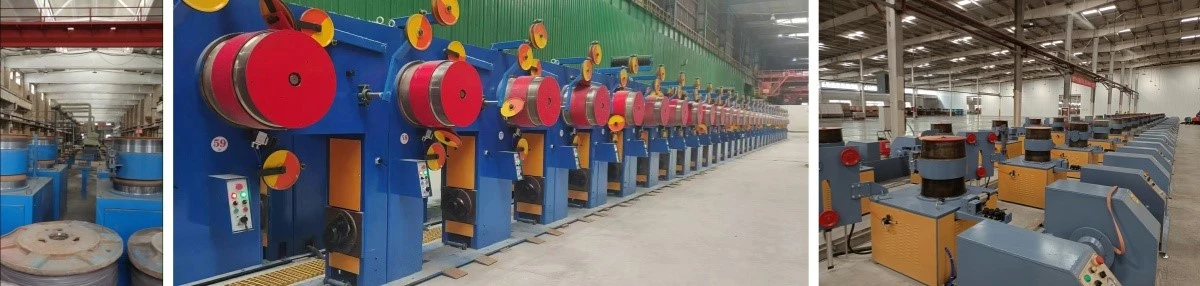
Heat Treatment Furnace
Name: Online Wire Heat Treatment Furnace For Hot dip Zinc-Aluminum Alloy Wire Equipment
Specification: The equipment is customized according to the type of wire products and the production line speed required by the user.
Overview:
This furnace is suitable for the online heat treatment process of low carbon wire. In order to ensure stable mechanical properties of the steel wire, the furnace adopts a box type structure with reinforced insulation layers on the furnace walls and roof, ensuring uniform and stable temperature control in the heating chamber. The heat treatment furnace is equipped with multiple heating and temperature measuring points, and the temperature is automatically controlled by a PID system. The process temperature of the heat treatment furnace is controlled within the range of 650 to 850 degrees Celsius.
Application Parameters
|
Application |
Construction Material |
Energy Source |
DV Value |
Wire Diameter Range |
|
Wire Heat Treatment |
Metal + Insulation |
Electricity / Natural Gas / Coal Gas |
40–200 mm·m/min |
Φ0.8–Φ8.0 mm |

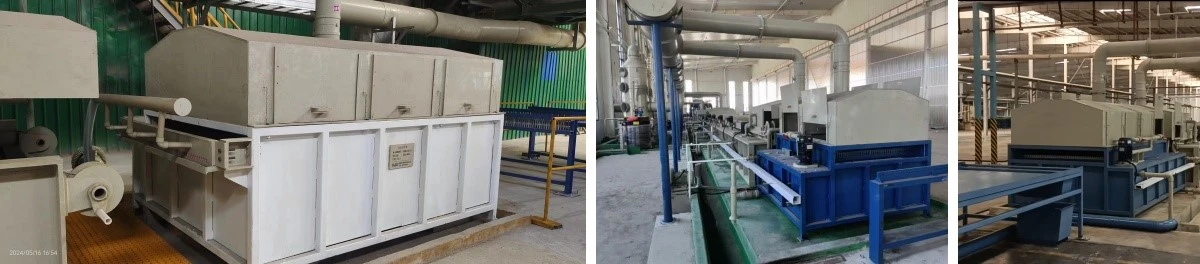
Temperature Controlled Cleaning Tank
Name: Temperature Controlled Cleaning Tank For Hot dip Zinc-Aluminum Alloy Wire Equipment
Specification: The equipment is customized according to the type of wire products and the production line speed required by the user.
Overview:
The tank body is fabricated by welding 304 stainless steel. In order to quickly and efficiently remove residual impurities from the steel wire surface, the tank adopts a two stage overflow cleaning system with independent circulation and a counter flow water supply and drainage method. Two overflow trays are installed and each tray is equipped with a corrosion resistant vertical pump with a motor power of 0.55 kW to provide overflow power. During the overflow cleaning process, water enters the cleaning tray in the form of jet flow. The cleaning water can be recycled, which reduces water consumption during the cleaning process and decreases wastewater discharge.
To prevent cleaning water from being carried into the next process, the outlet of the cleaning tank is equipped with interception stones and a back blowing air knife with a 5.5 kW blower to remove residual cleaning water from the steel wire surface. The equipment is designed as a fully enclosed structure with an openable threading cover and a reserved air inlet for connection to a purification tower.
Application Parameters
|
Application Position |
Material |
Energy Source |
DV Value |
Applicable Wire Diameter Range |
|
Electroplating Tank |
Stainless Steel |
Electricity |
20–80 mm·m/min |
Φ0.8–Φ8.0 (mm) |
Wire Pre Treatment Equipment
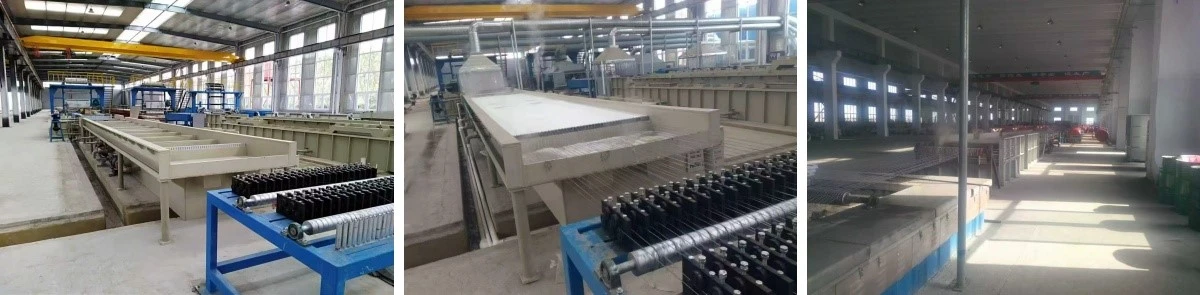
Ultrasonic Cleaning Tank
Name: Online Ultrasonic Cleaning Tank for Wire
Specification: The equipment is customized according to the type of wire products and the production line speed required by the user.
Overview:
The ultrasonic cleaning tank can replace both alkaline cleaning and acid pickling processes. Degreasing and rust removal are carried out simultaneously, which shortens the overall length of the production line.
The equipment adopts enclosed overflow type ultrasonic cleaning technology. The wire cleaning process is carried out in a completely enclosed cleaning space using an environmentally friendly ultrasonic cleaning solution based on weak phosphoric acid H3PO4. This process is suitable for wire cleaning and meets the speed requirements of hot dip galvanizing production lines. Ultrasonic cleaning is energy efficient and environmentally friendly and does not produce waste acid.
The ultrasonic cleaning tank is made of high strength PP material and is equipped with corrosion resistant circulation pumps. The lower liquid storage tank is divided into two independent sections A and B. When liquid in tank A is circulating, the liquid in tank B can be filtered cleaned and reused, allowing cleaning liquid maintenance without stopping the production line.
A sealed cover is installed above the cleaning tank to prevent vapor from escaping. During the cleaning process the wire is completely immersed in the cleaning solution. The system uses a two stage liquid storage design and each stage operates independently. An external cleaning solution circulation filtration tank and filter unit are installed so that the cleaning solution can be recycled which reduces material consumption.
Hydrochloric Acid Pickling Tank
Name: Online Wire Hydrochloric Acid Pickling Tank
Specification: The equipment is customized according to the type of wire products and the production line speed required by the user.
Overview:
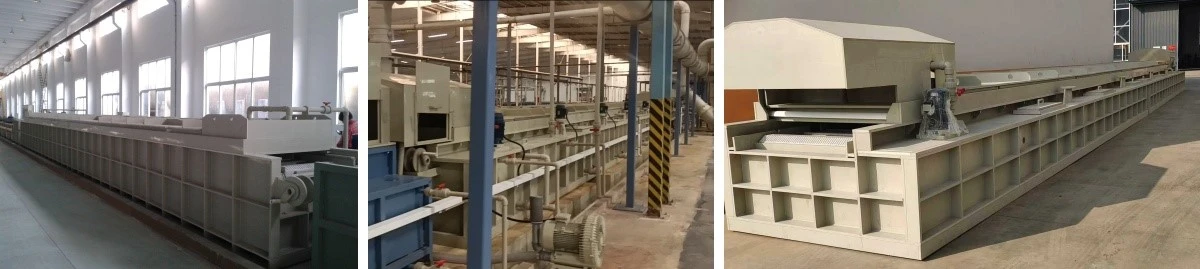
The integrated pickling tank is made of PP material. During the cleaning process, the wire moves in a straight line and the tank uses an overflow design. The tank is equipped with two corrosion resistant pumps with a motor power of 4.0 kW for the water curtain, and six acid resistant pumps with a motor power of 0.55 kW to provide acid overflow circulation.
The wire entry and exit of the tank are sealed with two water curtains, and both sides use groove seals to prevent acid mist from escaping. To ensure rapid removal of surface oxides and meet the speed requirements of the galvanizing process, the tank liquid is continuously circulated by acid resistant pumps, allowing the wire to be fully rinsed with hydrochloric acid to achieve the required pre galvanizing surface cleanliness.
To reduce acid consumption and prevent acid from entering the next process, the tank outlet is equipped with interception stones and a back blowing wiping system to remove residual acid from the wire surface.
Water Rinsing Tank
Name: Online Wire Water Rinsing Tank
Specification: The equipment is customized according to the type of wire products and the production line speed required by the user.
Overview:
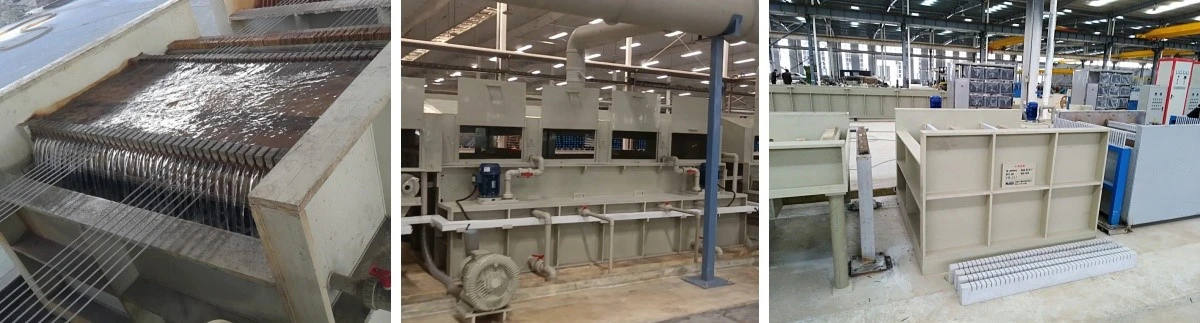
The tank body is fabricated from acid resistant materials. To quickly and efficiently remove residual impurities from the wire surface, the tank uses a two stage overflow cleaning system with independent circulation and a counterflow water supply and drainage method. Each tray is equipped with a corrosion resistant vertical pump with a motor power of 0.55 kW to provide overflow pressure. During the overflow cleaning process, water enters the cleaning trays in the form of jets. The cleaning water can be recycled, reducing water consumption and wastewater discharge.
To prevent cleaning water from entering the next process, the tank outlet is equipped with interception stones and a back blowing air knife with a 5.5 kW blower to remove residual water from the wire surface. The tank is designed as a fully enclosed structure with an openable threading cover and a reserved air inlet for connection to a purification tower.
Flux Tank
Name: Online Wire Flux Solution Cleaning Tank
Specification: The equipment is customized according to the type of wire products and the production line speed required by the user.
Overview:
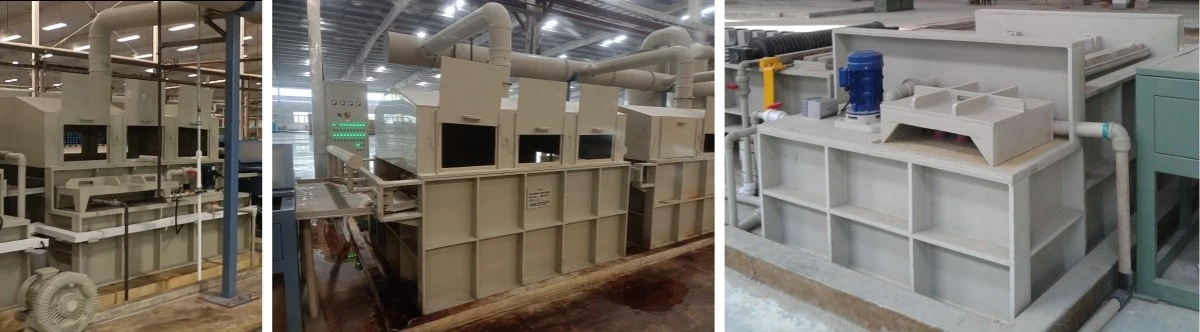
The enclosed flux solution cleaning tank is fabricated from reinforced PP material plates by welding. A layer of ammonium chloride aqueous solution is applied to the wire surface to prevent secondary oxidation and improve the bonding between the wire and the zinc bath. The flux solution tank uses an overflow circulation design.
A sealed cover is installed above the tank, and a ceramic air knife is positioned at the wire outlet to prevent flux solution from being carried out with the wire, avoiding contamination of downstream processes.
Cleaning Tank Application Parameters
|
Application Position |
Material |
Energy Source |
DV Value |
Applicable Wire Diameter Range |
|
Wire Pre-treatment Cleaning |
PP Sheet, Stainless Stee |
Electricity |
40–200 mm·m/min |
Φ0.8–Φ8.0 (mm) |
Drying Furnace
Name: Online Wire Drying Furnace For Hot dip Zinc-Aluminum Alloy Wire Equipment
Specification: The equipment is customized according to the type of wire products and the production line speed required by the user.
Overview:
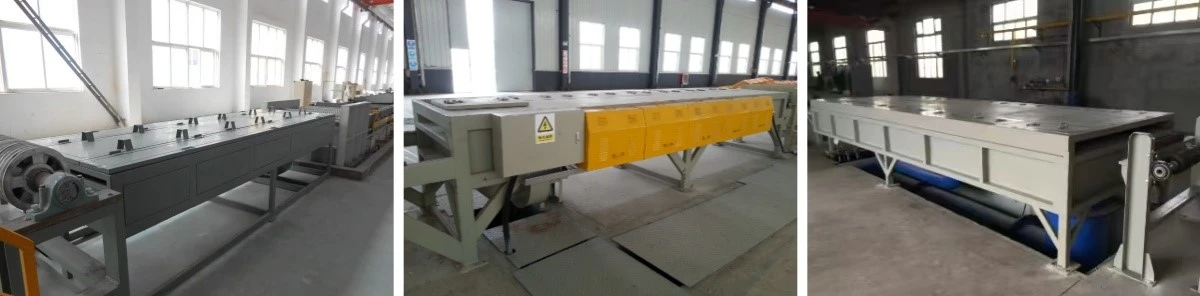
The equipment is designed based on the wire diameter, DV value, and production output. The drying furnace is constructed with a welded Q235 steel frame, and the interior of the chamber is insulated with high temperature resistant aluminum silicate fiber. Hot air is circulated through ducting to heat the furnace chamber, and an exhaust fan is installed at the rear. The operating temperature is maintained between 150 and 180 degrees Celsius.
Application Parameters
|
Application Position |
Material |
Energy Source |
DV Value |
Applicable Wire Diameter Range |
|
Pre-galvanizing Wire Drying |
Metal + Insulation |
Electricity, Gas |
40–180 mm·m/min |
Φ0.8–Φ8.0 (mm) |
Zinc Pot
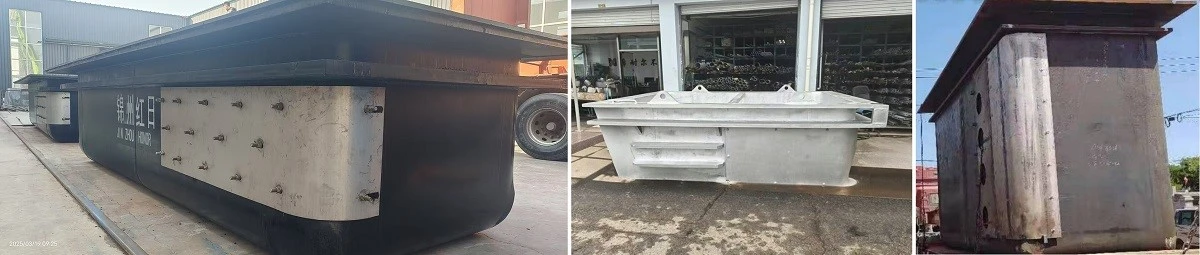
Metal Zinc Pot
Name: Metal Hot-Dip Galvanizing Pot
Specification: The equipment is customized according to the user's energy requirements and production line speed.
Overview:
The equipment is designed based on the user's energy choice, wire diameter, DV value, and production output, with a molten zinc capacity of 35 to 180 tons. The galvanizing pot is made of XG08 metal or stainless steel and is used together with the furnace. The heating method is external, and the energy source can be either electricity or natural gas.
The pot temperature is controlled by a corrosion resistant thermocouple, which is in direct contact with the molten zinc to ensure stable and accurate temperature control. The expected service life of the galvanizing pot is 5 to 8 years.
Application Parameters
|
Application Position |
Material |
Energy Source |
DV Value |
Applicable Wire Diameter Range |
|
Hot-Dip Galvanizing Zinc Bath |
XG08 Metal + Stainless Steel |
Electricity, Gas |
40–200 mm·m/min |
Φ0.8–Φ8.0 (mm) |
Ceramic Zinc Pot
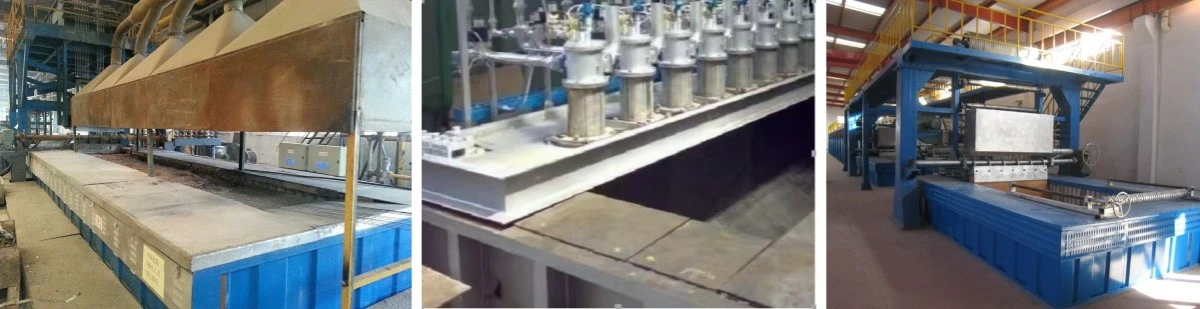
Name: Internally Heated Ceramic Galvanizing Pot
Specification: The equipment is customized according to the type of wire products.
Overview:
The equipment is designed based on the wire diameter, DV value, and production output, with a molten zinc capacity of 35 to 150 tons. The pot has a steel outer shell, ceramic inner lining, and an internal heating system installed on the inner wall of the pot to ensure uniform temperature in the working zone.
The pot temperature is controlled using a corrosion resistant thermocouple in direct contact with the molten zinc, ensuring stable and accurate temperature control. The expected service life of the ceramic galvanizing pot is more than 10 years.
Application Parameters
|
Application Position |
Material |
Energy Source |
DV Value |
Applicable Wire Diameter Range |
|
Hot-Dip Galvanizing Zinc Bath |
Steel Structure + Ceramic |
Electricity, Gas |
40–200 mm·m/min |
Φ0.8–Φ8.0 (mm) |
Vertical Gantry Frame for Zinc Bath
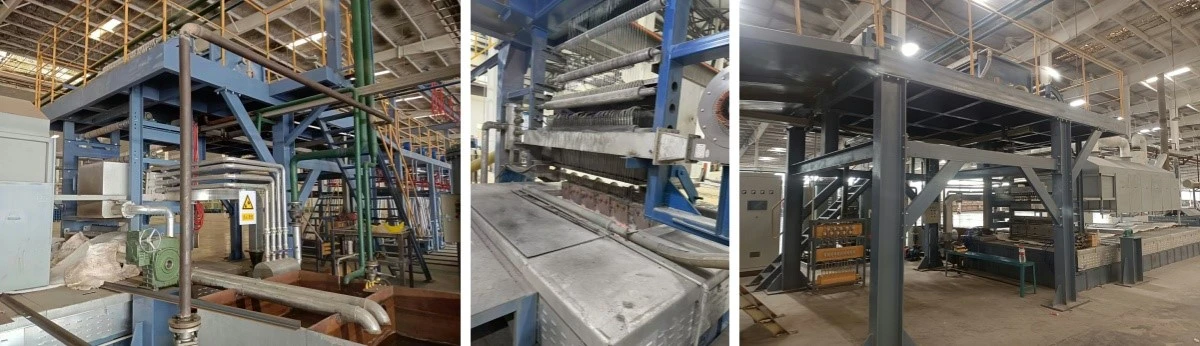
Name: Zinc Bath Gantry Frame (Vertical Steel Frame)
Specification: The equipment is customized according to the type of wire products and the production line speed required by the user.
Overview:
The equipment is designed based on the wire diameter, DV value, and production output. A vertical steel gantry frame is installed on the zinc bath to ensure stable operation of the equipment and achieve uniform hot-dip galvanizing of the wire.
The vertical steel frame is constructed from structural steel, and auxiliary equipment such as wire support rollers, air and water cooling devices, guide rollers, wire guiding shafts, and wiping systems are mounted on the frame.
Application Parameters
|
Application Position |
Material |
Energy Source |
DV Value |
Applicable Wire Diameter Range |
|
Hot-Dip Galvanizing Zinc Bath |
Steel Structure |
- |
40–200 mm·m/min |
Φ0.8–Φ8.0 (mm) |
Ceramic Pressure Roll
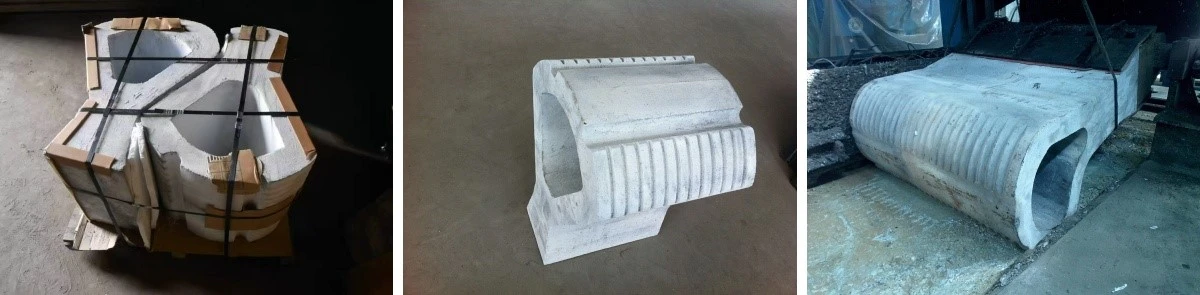
Name: Synthetic Silicon Nitride Ceramic Pressure Roll
Specification: The equipment is customized according to the type of wire products and the production line speed required by the user.
Overview:
The pressure roll is made of sintered synthetic silicon nitride ceramic. The ceramic pressure rolls are available in two independent structures for high-zinc and standard-zinc wires, but they share the same installation position, ensuring consistent zinc coating weight and reducing production costs.
The silicon nitride ceramic pressure rolls feature high strength, excellent wear resistance, and corrosion resistance to molten zinc. The pressure roll assembly uses a two-stage reduction gear flip structure, allowing the exit angle to be freely adjusted. The expected service life is five years or more.
Application Parameters
|
Application Position |
Material |
Energy Source |
DV Value |
Applicable Wire Diameter Range |
|
Hot-Dip Galvanizing Zinc Bath |
Silicon Nitride |
- |
8–60 mm·m/min |
Φ0.8–Φ8.0 (mm) |
Coating Wiping System
Name: Wire Hot-Dip Galvanizing Wiping System
Specification: The equipment is customized according to the wire diameter, DV value, and production output required by the user.
Overview:
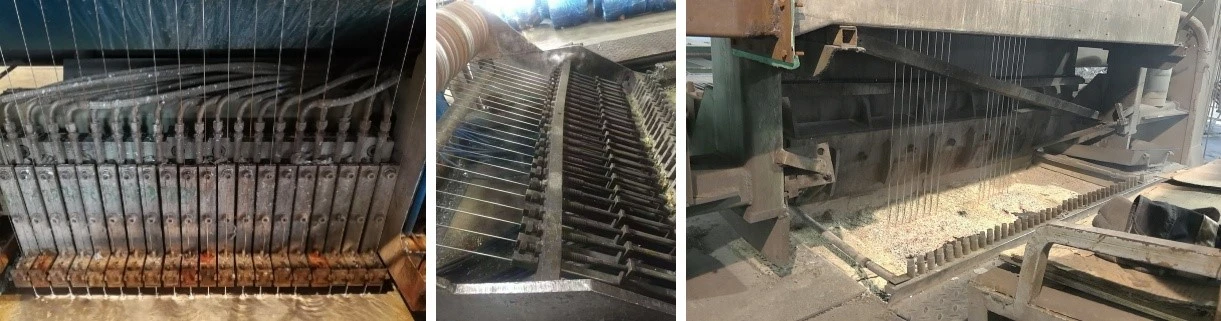
The wire wiping method is selected based on the required zinc coating thickness, DV value, and production output. Available wiping technologies include fiber pressure block wiping, nitrogen gas air knife wiping, electromagnetic wiping, and traditional charcoal wiping, all of which are used to control the zinc coating thickness on the wire surface.
The system is capable of controlling the zinc coating thickness in the range of 50 to 460 grams per square meter.
Application Parameters
|
Wiping Method |
Number of Steel Wires |
DV Value |
Applicable Wire Diameter Range |
|
Fiber Pressure Block Wiping |
36-42 wires |
60-90 mm·m/min |
Φ0.8-Φ8.0 mm |
|
Nitrogen Protection Wiping |
32-42 wires |
60-120 mm·m/min |
Φ0.8-Φ8.0 mm |
|
Nitrogen Air Knife Wiping |
12-22 wires |
80-200 mm·m/min |
Φ0.8-Φ8.0 mm |
|
Electromagnetic + Nitrogen Wiping |
12-22 wires |
80-200 mm·m/min |
Φ0.8-Φ8.0 mm |
|
Charcoal Wiping |
22-60 wires |
40-50 mm·m/min |
Φ0.8-Φ8.0 mm |
Zinc Coating Thickness Control System
Name: Wire Hot-Dip Galvanizing Online Zinc Coating Thickness Detection System
Specification: The equipment is customized according to the type of wire products and the production line speed required by the user.
Overview:
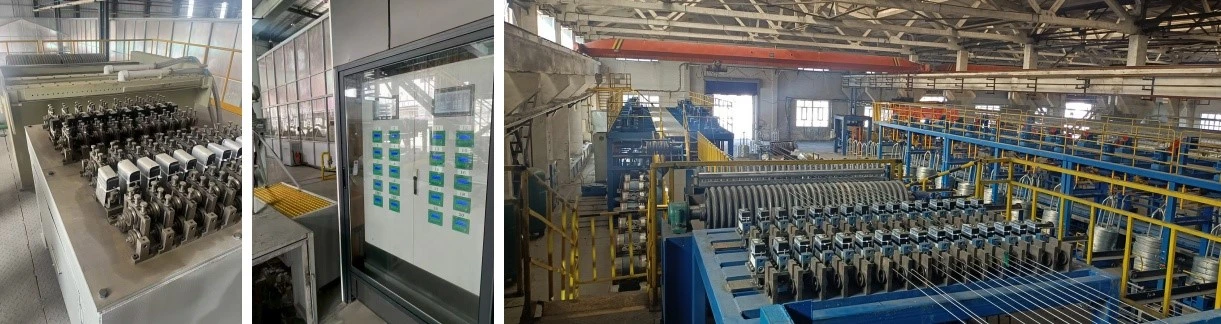
The system is suitable for steel wire hot-dip galvanizing production lines using nitrogen gas wiping or electromagnetic wiping systems. Online zinc coating thickness detection is based on a comparison method for monitoring and control.
During production, the target zinc coating thickness and allowable deviation (typically ±20 grams per square meter) are set on the HMI. The detector continuously transmits real-time data to the PLC, which adjusts the opening and closing of solenoid valves in the nitrogen gas line as needed. By controlling the flow and pressure of the nitrogen air knives, the system precisely regulates the zinc layer thickness, making operation and adjustments simpler and more convenient.
Application Parameters
|
Application Position |
Material |
Energy Source |
DV Value |
Applicable Wire Diameter Range |
|
After Wire Galvanizing |
Metal |
Electric Power |
100-200 mm·m/min |
Φ1.2-Φ8.0 mm |
Wire Take-Up Unit
Name: Wire Take-Up Unit
Specification: The equipment is tailored to the type of wire products and the production line speed specified by the user.
Overview:
The design of the equipment takes into account wire diameter, DV value, and production output. It is suitable for winding wire after hot-dip galvanizing or electro-galvanizing. The take-up unit is selected based on the wire's post-galvanizing diameter, material, and intended use. The unit can handle wire reels weighing from 35 to 2000 kilograms.
Application Parameters
|
Winding Machine Type |
Material |
Energy Source |
Applicable Wire Diameter Range |
Reel Weight |
|
Horizontal Winding Machine |
Metal |
Electric Power |
Φ1.0–Φ6.0 mm |
0.2–0.8t |
|
Star Inverted Winding Machine |
Metal |
Electric Power |
Φ1.2–Φ8.0 mm |
0.8–2.0t |
|
Spool Winding Machine |
Metal |
Electric Power |
Φ0.6–Φ8.0 mm |
0.5–0.8t |
|
Elephant Nose Winding Machine |
Metal |
Electric Power |
Φ0.6–Φ1.6 mm |
20–50 kg |

Wire Bundling Machine
Name: Wire Bundling Machine
Specification: The equipment is configured according to the application and specifications of the wire products.
Overview:
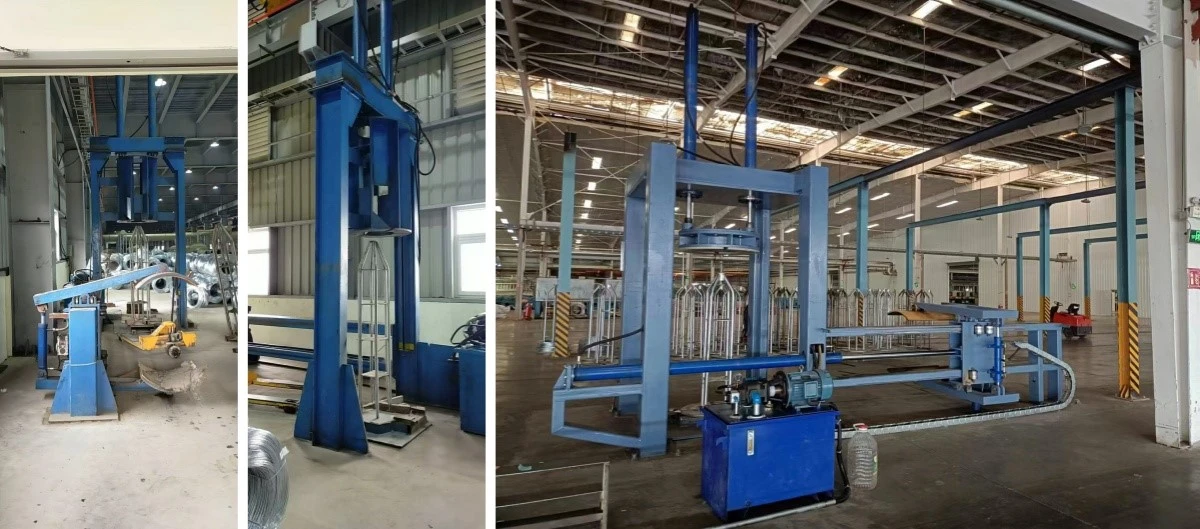
This machine is used for bundling large wire reels after hot-dip or electro-galvanizing take-up. The hydraulic unit features a welded structural steel frame, providing a robust, all-metal construction. The top section is fitted with dual hydraulic cylinders, bolted to the lower pressing basket for convenient transport. A long-arm design allows the machine to handle reels weighing from 800 to 2000 kilograms.
Application Parameters
|
Application Position |
Material |
Energy Source |
Applicable Wire Diameter Range |
Coil Weight |
|
After Wire Winding and Strapping |
Metal |
Electric Power, Hydraulic |
Φ1.6–Φ8.0 mm |
0.8–2.0t |
Product Advantages
1.Revolutionary Corrosion Performance with Zinc-Aluminum Alloy Coating
The primary advantage of this equipment is its ability to apply a Zinc-Aluminum alloy coating, typically containing 5% or 10% aluminum, which delivers a quantum leap in corrosion resistance. In standardized salt-spray tests, Zn-Al coatings consistently outperform pure zinc coatings by a factor of two to three. This remarkable performance is attributed to the formation of a dense, stable, and self-healing aluminum oxide (Al₂O₃) layer on the coating's surface. This oxide layer acts as an exceptional barrier against moisture, chlorides, and other corrosive agents, making Zn-Al alloy wire the unrivaled choice for the most aggressive environments, including coastal infrastructure, offshore platforms, and high-salinity agricultural applications.
2.Precision Temperature Management for Alloy Bath Stability
Galvanizing with a Zn-Al alloy bath is more demanding than pure zinc, as the alloy is more sensitive to temperature fluctuations. This equipment is specifically engineered to meet these challenges with advanced heating systems, available in both metal and ceramic zinc pot configurations. These systems are designed to maintain a stable and uniform bath temperature within the narrow operating window required for the alloy. The precision temperature control, utilizing corrosion-resistant thermocouples in direct contact with the molten metal, is paramount for controlling the formation of the critical Al-rich inhibition layer. This layer is the foundation for superior coating adhesion and the prevention of brittle intermetallic growth.
3.Superior Pre-Treatment with Advanced Ultrasonic Cleaning
The pre-treatment line is designed with an optional but highly recommended ultrasonic cleaning module. This state-of-the-art module uses an environmentally friendly, mild phosphoric acid solution to simultaneously degrease and de-rust the wire in a single, highly efficient process. The ultrasonic cavitation action reaches microscopic crevices and removes tenacious organic contaminants that conventional pickling can miss. This is absolutely essential for Zn-Al alloy galvanizing, as any surface contamination, no matter how small, can disrupt the formation of the Al-rich inhibition layer, leading to coating defects, poor adhesion, and premature failure.
4.High-Precision Coating Control for a Difficult Alloy
The wiping system on this line is specifically calibrated for the unique rheology of Zn-Al alloys, which have lower surface tension and different fluidity characteristics compared to pure zinc. The system offers advanced wiping technologies, particularly the highly precise electromagnetic and nitrogen air knife systems. These non-contact methods provide unparalleled control over the coating thickness and surface finish, ensuring a smooth, uniform, and consistent coating. The integrated online coating control system provides real-time feedback and automatic adjustment, guaranteeing that every meter of wire meets the stringent coating weight specifications required for Zn-Al alloy products.
5.Reduced Environmental Impact and Resource Efficiency
This equipment line incorporates sustainable design features that minimize its environmental footprint. The ultrasonic cleaning module uses a weak acid solution and produces no waste acid, offering a significant environmental benefit over traditional acid pickling. The entire pre-treatment section is enclosed to capture and neutralize fumes. Additionally, the Zn-Al alloy's superior corrosion resistance allows for the use of a thinner coating to achieve equivalent protection to a much thicker pure zinc coating, thereby reducing the overall consumption of valuable zinc and aluminum metals and the energy required to melt them.
6.Versatile Zinc Pot Options for Different Production Needs
The system offers both metal and ceramic zinc pot options, each with distinct advantages. The metal zinc pot, made from XG08 material, provides a cost-effective solution with a service life of 5-8 years. The ceramic zinc pot, featuring a steel shell with a ceramic inner lining and internal heating, offers superior thermal efficiency, more uniform temperature distribution, and an extended service life of over 10 years. This versatility allows manufacturers to choose the pot that best fits their budget, production volume, and quality requirements for Zn-Al alloy processing.
FAQ
Q1: Why is the Zn-Al alloy coating so much more corrosion-resistant than pure zinc, despite having a lower zinc content?
The secret lies in the chemistry of the coating and the formation of a dual-layer structure. The aluminum in the alloy reacts preferentially with oxygen to form a dense, stable, and strongly adherent layer of aluminum oxide (Al₂O₃) on the surface. This oxide layer is extremely impermeable and acts as an exceptional physical barrier, far superior to the softer, more porous zinc oxide and carbonate layer formed on pure zinc. Additionally, an Al-rich inhibition layer forms at the coating-steel interface, which prevents the growth of brittle zinc-iron intermetallics, making the overall coating more ductile and resistant to cracking. The Al₂O₃ layer is also self-healing; if scratched, it quickly reforms.
Q2: What are the primary challenges when galvanizing with a Zn-Al alloy, and how does your equipment overcome them?
The primary challenges are the alloy's increased reactivity with steel, its greater sensitivity to temperature, and its lower surface tension. Our equipment overcomes these challenges through precise engineering. The zinc pot temperature is controlled to within very tight tolerances using advanced PID controllers. The pot itself, especially the ceramic option, is designed to minimize temperature gradients with its internal heating system. The wiping system is specifically calibrated for the alloy's lower surface tension, using precise air knife pressures or electromagnetic field strengths to achieve uniform coating removal. The pre-treatment process is also more critical, hence the emphasis on ultrasonic cleaning for a perfectly clean surface.
Q3: Is the ultrasonic cleaning module really necessary, or can the line run without it?
The line can certainly run without the ultrasonic cleaning module using a standard hydrochloric acid pickling and rinsing sequence. However, we strongly recommend the ultrasonic cleaning module for Zn-Al alloy processing. The standard pickling process is effective but can leave microscopic residues or result in slight surface oxidation if not perfectly controlled. The ultrasonic cleaning provides a superior, more consistent clean, which is essential for the reliable formation of the Al-rich inhibition layer. The improved adhesion and reduced defect rate that it provides typically result in a quick return on investment, especially for high-value alloy coating applications.
Q4: What is the expected service life of a ceramic zinc pot for zinc-aluminum alloy galvanizing applications?
The ceramic zinc pot is engineered for long-term, reliable operation with a robust steel shell, advanced ceramic lining, and internally integrated heating system.For zinc-aluminum alloy galvanizing, where the molten bath is more aggressive and chemically reactive than conventional zinc, ceramic zinc pots provide significant performance advantages compared with traditional steel pots. Under normal operating conditions, the expected service life can exceed 10 years.Unlike conventional metal zinc pots, the ceramic zinc pot eliminates internal metallic components that may react with molten zinc alloys. This significantly reduces corrosion, minimizes dross formation, and prevents premature pot failure-issues commonly encountered when processing reactive alloys such as Zn-Al.With superior corrosion resistance, stable thermal performance, and extended service life, ceramic zinc pots provide a reliable and cost-effective solution for demanding high-temperature galvanizing applications..
Q5: Can this equipment be switched between processing Zn-Al alloy wire and standard galvanized wire?
Yes, the equipment is designed with a degree of flexibility. Switching between the two processes primarily involves changing the zinc bath material and composition, which would require a full pot change and recalibration of the temperature control system. The wiping and coating control systems are software-configurable to handle both pure zinc and Zn-Al alloys. However, it's essential to understand that cross-contamination can occur, so dedicated pots for each alloy are recommended for consistent product quality, especially in a high-volume production environment. A full changeover typically takes several days.
Q6: What is the role of the flux solution in Zn-Al alloy galvanizing?
The flux solution, typically an aqueous solution of ammonium chloride, plays a critical role in Zn-Al alloy galvanizing. After the wire has been cleaned and rinsed, it passes through the flux tank, which applies a thin, protective layer to the wire surface. This layer serves two key functions: it prevents the clean wire from oxidizing before it enters the zinc bath, and it acts as a wetting agent, promoting a strong chemical reaction between the steel and the molten Zn-Al alloy, ensuring a uniform, adherent coating with minimal voids or bare spots.
Hot Tags: hot dip zinc-aluminum alloy wire equipment, China hot dip zinc-aluminum alloy wire equipment manufacturers, suppliers, factory


